
Blockchain Development Use Cases and Architecture
For organizations evaluating blockchain as infrastructure — not speculation — and building systems of trust at scale.
As the distributed ledger technology (DLT) space matures, the narrative has shifted from speculation to infrastructure. Today, blockchain development is a fundamental discipline for organizations looking to solve complex problems of trust, transparency, and efficiency. It is no longer just about cryptocurrencies; it is about building resilient, decentralized systems that can operate across borders without a central intermediary.
What Modern Blockchain Development Really Involves
Modern blockchain development goes far beyond writing code to transfer tokens. It involves designing a system of distributed nodes that must achieve consensus without knowing or trusting each other. This requires a deep understanding of distributed systems, cryptography, and game theory.
At its core, the development process involves creating a stack that allows data to be stored immutably, validated by the network, and accessed via client applications. We are not just building databases; we are building economic and social protocols.
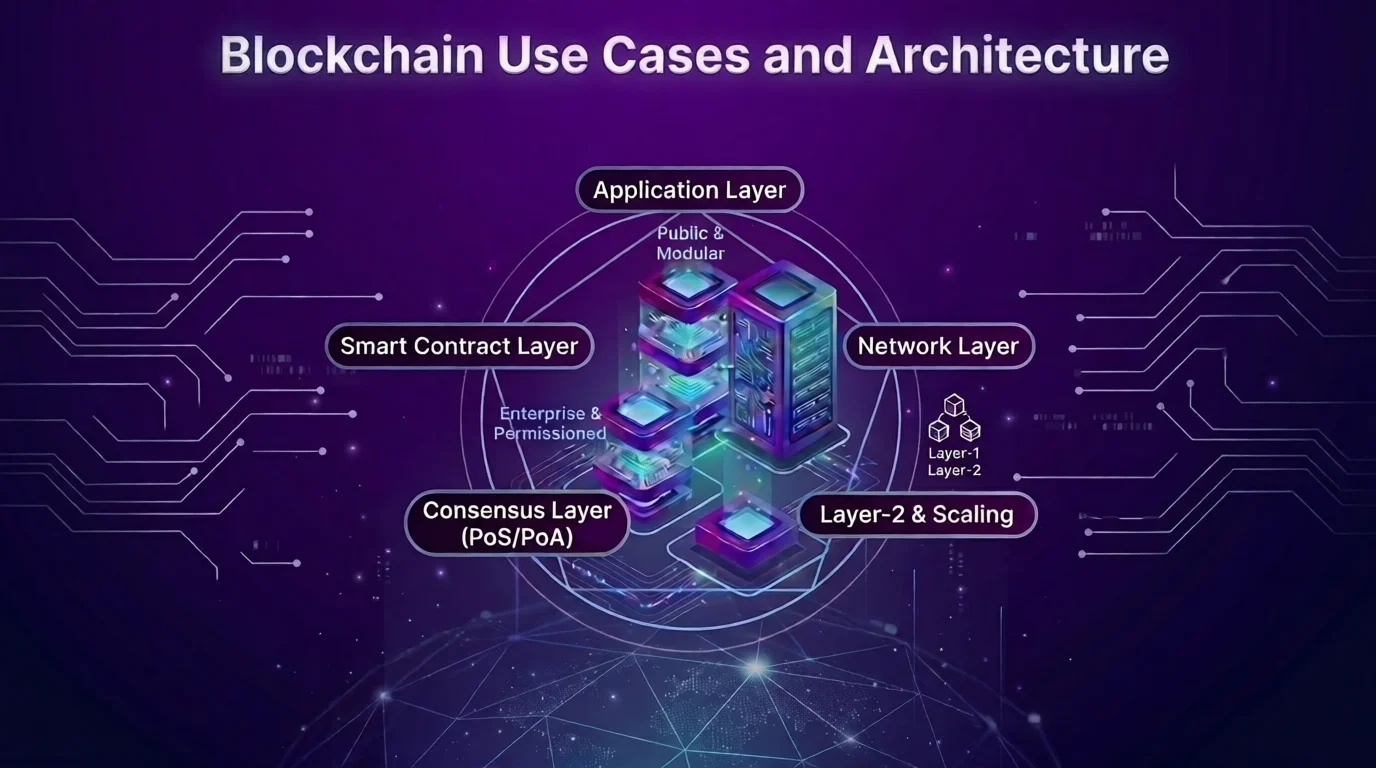
Core Components of Blockchain Architecture
To architect a robust blockchain solution, one must understand the four distinct layers that make up the technology stack. These layers must work in harmony to create a functional application.
In a peer-to-peer (P2P) network, nodes must discover each other and propagate transactions and blocks. The architecture must handle network partitions, latency, and asynchronous communication to ensure the ledger remains consistent.
Whether it is Proof of Stake (PoS), Proof of Authority (PoA), or Delegated Proof of Stake, the consensus layer ensures that all participants agree on the state of the ledger. Choosing the right consensus mechanism is a trade-off between security, decentralization, and scalability.
Smart contracts define the business rules, triggering transactions when conditions are met. Development at this layer requires rigorous security standards to prevent logic flaws that could lead to the loss of assets.
This is the interface that users interact with. It includes web frontends, mobile wallets, and backend APIs that bridge the gap between the off-chain world and the on-chain data.
Smart Contracts and Decentralized Logic
Smart contracts are the "trustless" engine of the blockchain. However, writing them requires a different mindset than traditional software engineering. Because code deployed to a blockchain is immutable (usually), bugs are permanent. There is no "hotfix" button.
Blockchain smart contracts development services focus heavily on security patterns and auditability. Developers must guard against common vulnerabilities like reentrancy attacks, integer overflows, and logic errors. Furthermore, gas optimization is critical. Every operation on a public chain costs money (gas fees). Inefficient code can render an app unusable due to high costs.
Blockchain Wallet Development Infrastructure
If the blockchain is the bank, the wallet is the interface users interact with. Blockchain wallet development services must balance security with usability.
There is a critical distinction between custodial and non-custodial wallets. Custodial wallets hold the user's private keys, much like a traditional bank. They are easier to recover but require trust in the service provider. Non-custodial wallets give the user full control of their keys but place the burden of security squarely on the user — if they lose their keys, they lose their assets.
Modern wallet development increasingly utilizes Multi-Party Computation (MPC) and social recovery to bridge this gap.
Custom Blockchain Development vs Using Existing Networks
A common question businesses face is whether to build a proprietary chain or utilize existing networks. Custom blockchain development is resource-intensive and risky. Building a new consensus mechanism, securing a new network, and attracting validators is a monumental task.
In most cases, building on an existing ecosystem like Ethereum or Solana, or utilizing a modular framework like Cosmos, is the superior strategic choice. It provides immediate network security, liquidity, and interoperability. However, hyperledger blockchain development services are the exception for enterprises that require strict privacy controls that public chains cannot offer.
Understanding Blockchain App Development Cost
The cost of building a blockchain solution is highly variable, driven by complexity rather than just lines of code. When analyzing blockchain app development cost, stakeholders must account for several distinct drivers:
- Complexity of Architecture: A simple token on Ethereum is cheap; a cross-chain DeFi protocol with liquidity pools is expensive.
- Smart Contract Development & Audits: Writing the contracts is step one. Step two is paying top-tier security firms to audit them. This is a non-negotiable cost for any project handling real value.
- Security Audits: A single vulnerability can result in millions in losses. Comprehensive audits often cost more than the initial development.
- Node Infrastructure: Running and maintaining nodes, especially for private chains, involves cloud hosting costs and DevOps resources.
- UI/UX Development: The frontend must interact with the blockchain in a way that abstracts complexity from the user.
How to Evaluate a Blockchain App Development Company
Choosing the right partner is a strategic decision. When looking at top blockchain development companies, technical depth is the primary differentiator.
A competent partner should not just know Solidity or Rust; they should understand distributed systems architecture. Look for a blockchain app development company that prioritizes a security-first mindset.
Architectural Best Practices in 2026
As we look toward the mid-2020s, best practices are solidifying around modularity and interoperability.
- Layer-2 Scaling Solutions: It is becoming standard to build Layer-2 applications (like Optimism, Arbitrum, or Lightning) to inherit the security of a Layer-1 while offering lower fees and higher throughput.
- Modular Blockchain Design: Separating the execution layer from the settlement and data availability layers allows for greater specialization and scalability.
- Interoperability Protocols: Systems can no longer exist in silos. Architectures must incorporate bridges and cross-chain messaging protocols (like Chainlink CCIP or IBC) to allow assets and data to move freely between networks.
- Security-First Architecture: Security must be proactive, not reactive. Formal verification of smart contracts and zero-knowledge proof implementations are becoming standard for privacy-preserving applications.
Blockchain is not a magic bullet. It is a complex infrastructure investment that should be pursued only when the business case justifies the trade-offs. Avoid trend-driven adoption.
Focus on alignment with your business model. If you need a shared source of truth among mistrusting entities, blockchain is the right tool. If you simply need a fast database, a traditional SQL solution might be better. Prioritize scalability and compliance from day one. The regulatory environment for digital assets is tightening, and your architecture must be able to adapt to new compliance requirements.