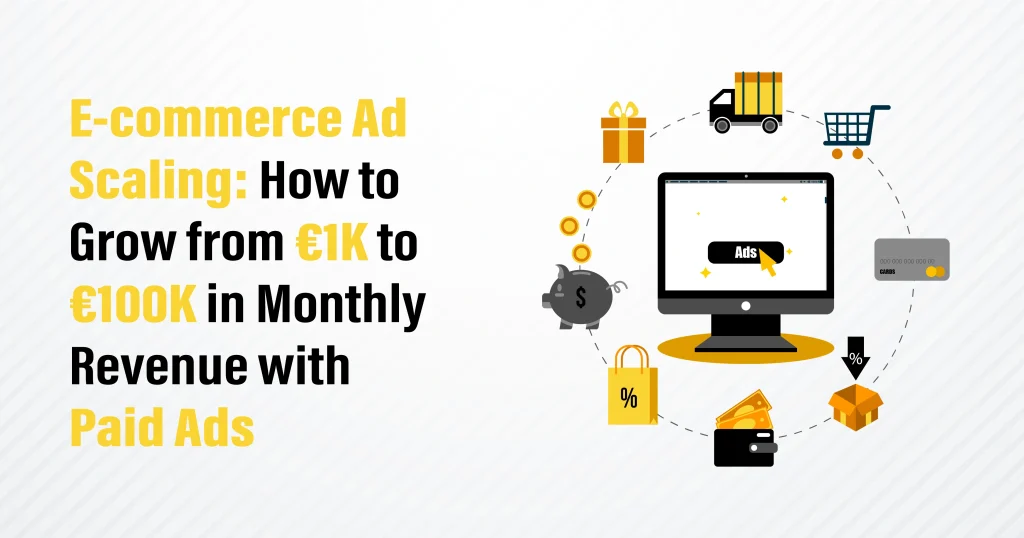
E-commerce’s serious growth is anchored on ad scaling. It is not only a matter of making more ads, but it is about making the right ads, at the right time, using the right frameworks.
Regardless of whether you run a Shopify store or any other online platform, making the jump between having a monthly €1K turnover and €100K turnover is a data-driven endeavor. You have to be aware of how various platforms operate, how to spend your budget, and how to scale without losing any profits.
In this guide, we will discuss the path to scaling your ads, step-by-step, as you go through the first profitable month of €1K to building a 6-figure machine using Facebook, Google and TikTok Ads. All the sections target best-proven strategies that will work in 2026 and beyond.
The main reason why many E-commerce brands fail at the scaling stage is that they pursue revenue without safeguarding profitability. The secret of long-term success is to understand how to scale ecommerce ads and maintain a good ROAS and margins.
Uncontrolled rapid growth usually causes increasing CPAs, low conversion rates, and ad fatigue. Thus, the metrics that you need to pay attention to when scaling are:
The idea is to grow in a sustainable manner. Test small and then optimize it with real data. Do not ramp-up spending until you get some stability. You do not want to make emotional decisions, follow your numbers. Moreover, monitor performance with tools such as Google Analytics, Meta Ads Manager, and Triple Whale. Sustainable ad scaling is not spending maniacally, but managing controlled growth.
There is a systematic way your Shopify scaling strategy must proceed:
Use tools like Klaviyo to automate email flow, ReConvert to automate post-purchase upsells, and Zipify to create landing pages. These tools grow LTV (Lifetime Value), and the scaling becomes more profitable. It is crucial to note that front-end scaling will fail without a robust backend.
Facebook ad scaling for ecommerce in 2026 requires a level-headed, scalable strategy.
CBO (Campaign Budget Optimization) allows Facebook to allocate budget among ad sets automatically in case sufficient data is present. ABO (Ad Set Budget Optimization) is tighter and functions more effectively in the case of testing.
2 fundamental scaling techniques exist:
Pay close attention to the watch frequency. Unless there are conversions, change creatives when it goes above 3.
Use Advantage+ Shopping campaigns to automate broad targeting, creative testing and efficient scale in cold traffic. As a result, use a mix of both approaches to expand successfully: horizontal scaling adds scale, vertical scaling adds volume, combine them and grow long term.
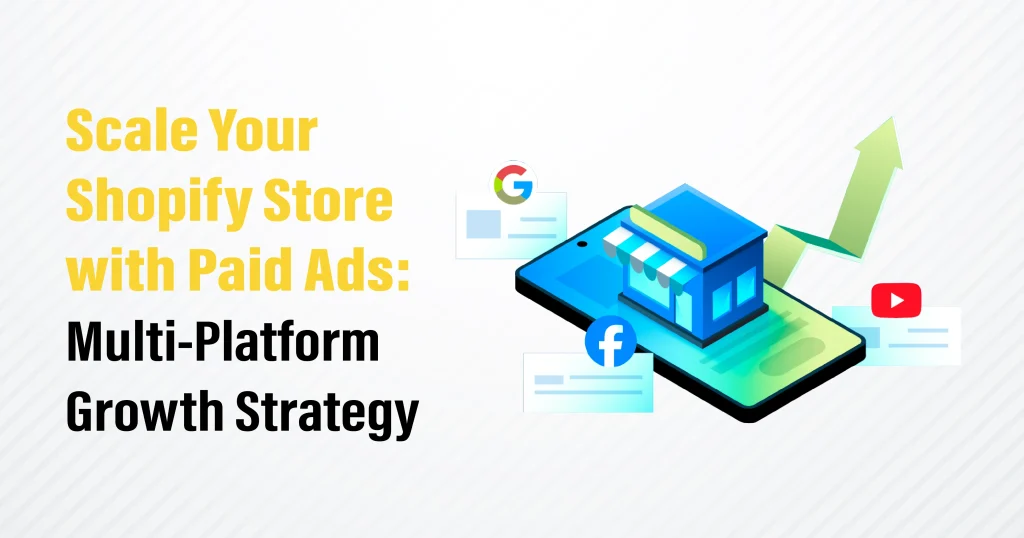
In order to scale Shopify stores with paid ads, you should have a variety of traffic sources. Using a single medium to reach your customers may restrict your expansion and also jeopardize your business.
Craft a consistent message on different media platforms. Keep your branding consistent, retarget intelligently, and use UTM parameters to track attribution. This is simplified by the Shopify ecosystem, which includes integrated analytics, quick checkout, and app attachments so you can understand your performance in real time.
Reaching €100K/month requires an ad strategy for 6-figure ecommerce, which implies not random testing but system-building.
Here’s how:
Scaling doesn’t mean doing more; it means doing it smarter. To scale, test, and launch new campaigns, use SOPs (Standard Operating Procedures).
You need to concentrate on quality over quantity to increase the ROAS of e-commerce ads during ad scaling.
Use A/B testing to test and enhance every step of the funnel. Utilize CRO tools such as Hotjar, VWO, and Google Optimize. Every euro that you spend must be justified by a quantifiable value. ROAS is not merely a result; it is an approach.
Navigating the appropriate paid traffic for ecommerce stores is subject to the stage of development you are in.
Combine channels in order to have a full-funnel approach. As an example, you can utilize TikTok to launch the product, Meta to retarget it, and close it using Google Search or Shopping. Adjust your spend according to CAC, ROAS, and conversion rates per channel.
Intelligent automation plays a key role when it comes to Google Ads scaling e-commerce in 2026.
Focus areas include:
For example, the budget can be raised by 20 percent when ROAS is more than 3x within 7 days. Google is incredibly efficient at turning bottom-funnel traffic, which should be a focal point of your scaling strategy.
TikTok ads for e-commerce growth offer a distinct advantage, but only as long as you follow the rules of the platform.
Moreover, TikTok Spark Ads allow you to scale-up organic postings with a proven engagement rate. This creates trust and performance simultaneously. Collaborate with micro-creators to gain credibility and skyrocket with new content. TikTok is best used for top of the funnel growth to provide warm traffic to Meta and Google.
Scaling an ecommerce brand with ads will be a time-consuming process, and you should not expect immediate results. The most realistic time frame includes 1-2 months aimed at testing products, audiences, and creatives. In this stage, you seek to break even and collect credible data. In months 3-4, when your systems work, you should begin to experience regular profitability and better ROAS. It is after Month 5 that you can start confident scaling, raising budgets, and expanding across the platforms.
Avoidable traps include:
Stay consistent. Scaling is not a single hack, but it is a set of building habits, systems, and resilience.
Ad scaling is not a task that you do once and then forget about it; it is a repeatable process.
Take small steps, experiment boldly, and scale by data. Stop wasting money, stop being less wise with it, and be more intelligent with the money by strategically spending it. Integrate performance marketing with CRO, LTV building, and retention. When you are serious about achieving that 100K/month, aim at creating a machine, not just campaigns.
Want to scale your shop? To kick off your 6-figure journey, book a consultation with our team of experts at Boost Agency Ltd and start your ecommerce ad scaling journey today.