
Foundations of Custom Blockchain Applications
For enterprise CTOs and startup founders architecting solutions that actually solve business problems.
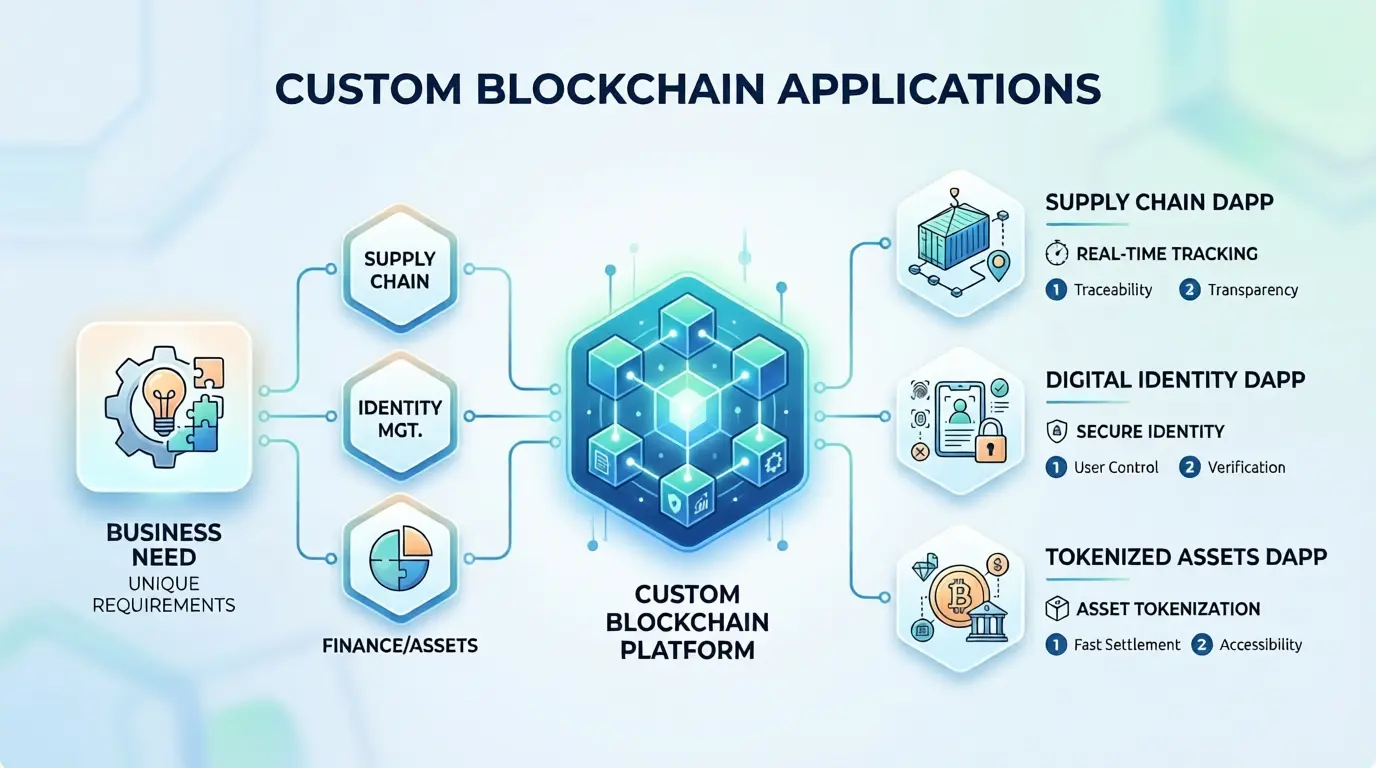
The landscape of distributed ledger technology has matured from experimental protocols to critical infrastructure. For enterprise CTOs and startup founders alike, the conversation has shifted from "what is blockchain?" to "how do we architect a solution that actually solves a business problem?" While public chains like Bitcoin and Ethereum receive the most media attention, the real engineering value often lies in custom blockchain development. Building a bespoke system allows organizations to tailor the technology to specific regulatory, performance, and governance requirements that generic networks simply cannot meet.
Why Custom Blockchain Development Matters
Off-the-shelf blockchain solutions are sufficient for simple token transfers or basic NFT minting. However, enterprise-grade applications often require more control. Custom blockchain development allows organizations to define their own consensus rules, privacy parameters, and transaction validation logic.
Business-driven architecture decisions are at the heart of this approach. A supply chain consortium, for example, requires permissioned access and private transactions, features native to public blockchains cannot provide without complex layering. Similarly, a high-frequency trading settlement network needs throughput speeds that general-purpose chains struggle to achieve.
Core Architectural Layers of Blockchain Applications
Understanding a custom blockchain requires dissecting it into its foundational layers. A robust architecture ensures that changes in one layer do not destabilize the others.
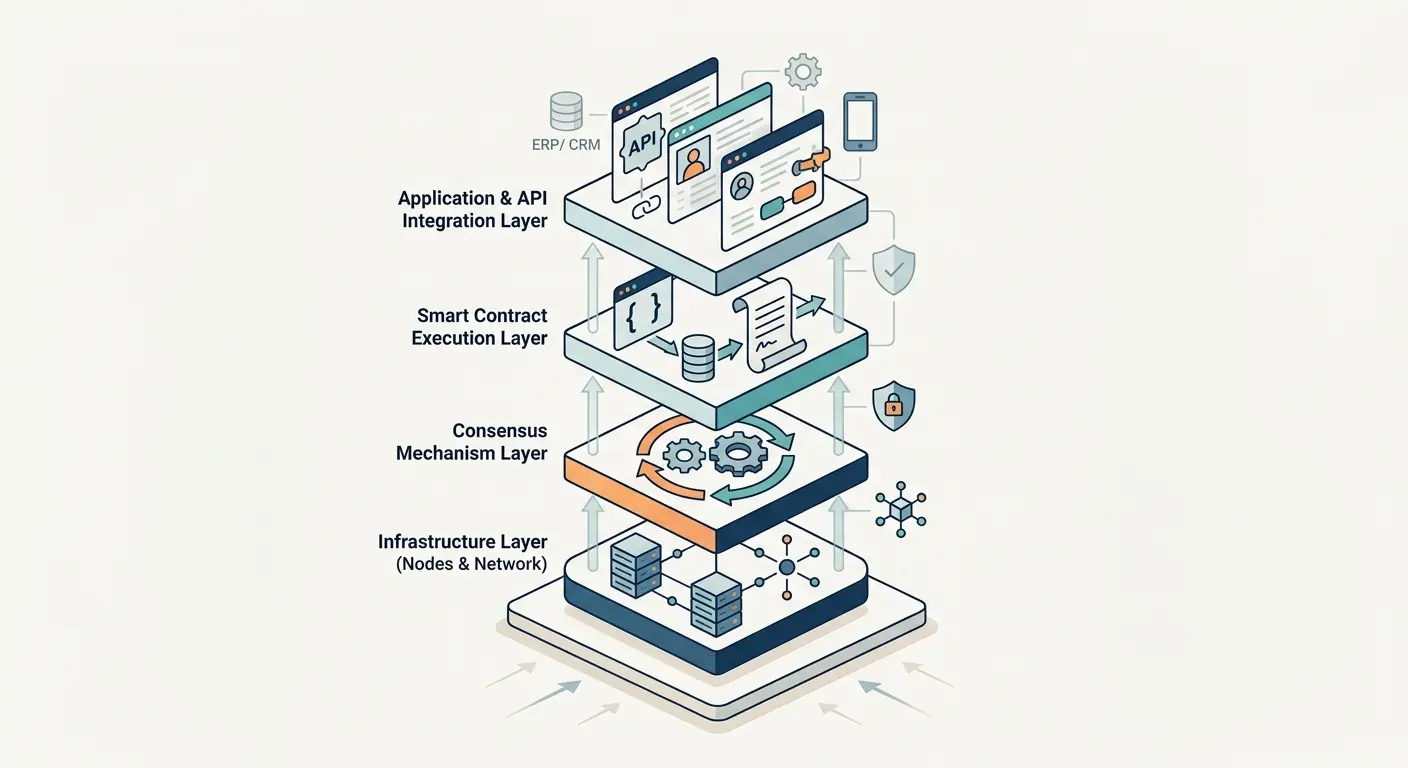
This is the physical and logical bedrock. It comprises the nodes (servers) that store the ledger and the peer-to-peer (P2P) network that allows them to communicate. In a custom setup, the infrastructure layer is designed for specific redundancy and latency requirements.
The consensus layer is the algorithm that ensures all nodes agree on the state of the ledger. While Bitcoin uses Proof of Work, custom applications often utilize Proof of Authority (PoA) or Proof of Stake (PoS).
This is the processing engine. It executes the business logic encoded in the blockchain. For custom chains, this might involve a specific virtual machine like the Ethereum Virtual Machine (EVM) or WebAssembly (WASM).
This is the interface that connects the blockchain to the outside world. It includes APIs that allow enterprise systems (ERPs, CRMs) to write data to the ledger and read from it.
Choosing the Right Blockchain Ecosystem
While custom development implies building from scratch, often the most strategic move is to build on top of an existing robust ecosystem. Choosing the right foundation is critical.
Ethereum blockchain development remains the standard for decentralized applications (dApps) requiring high security and deep liquidity. Its mature ecosystem of tools, wallets, and developer talent makes it a safe harbor for many projects.
When speed and cost are the primary constraints, Solana blockchain development offers a compelling alternative. Solana's unique Proof of History combined with Proof of Stake allows for thousands of transactions per second with minimal fees.
For enterprises that prioritize privacy and control above all else, hyperledger blockchain development services are the de facto standard. Hosted by the Linux Foundation, Hyperledger frameworks like Fabric are permissioned. Only known, verified entities can join the network. This is essential for sectors like banking and healthcare, where data privacy laws (GDPR, HIPAA) prevent putting sensitive data on a public ledger.
Designing Smart Contracts for Custom Applications
Smart contracts are the immutable logic engines of the blockchain. In a custom context, they automate complex business workflows, from trade settlements to royalty distributions. Leveraging blockchain smart contracts development services is crucial because the code is often handling significant value or sensitive logic.
Security is the paramount concern. Unlike traditional software, smart contracts cannot be easily patched once deployed. Vulnerabilities like reentrancy or arithmetic overflows can be catastrophic. Therefore, professional development involves rigorous testing, formal verification, and third-party audits.
Blockchain Wallet Development Infrastructure
The wallet is the user's gateway to the blockchain. It is not just a UI; it is a sophisticated cryptographic tool. Blockchain wallet development services must address the tension between security and usability.
- Custodial vs. Non-Custodial: Custodial wallets hold the user's private keys, acting like a bank. They are easier for recovery but introduce centralization risk. Non-custodial wallets give users full control but require them to manage their own keys, a high barrier for mainstream adoption.
- Security and Encryption: Modern wallet architecture increasingly utilizes Multi-Party Computation (MPC) to split keys across multiple devices or servers, enhancing security without sacrificing usability.
- Integration: Wallets must seamlessly sign transactions triggered by smart contracts and display complex data (like tokenized assets) in an understandable way.
Cost Drivers in Custom Blockchain Development
Understanding the blockchain app development cost requires looking beyond the initial coding phase. Several variables drive the final budget:
- Architecture Complexity: A simple private chain is cheaper to deploy than a complex interoperable system bridging multiple public networks.
- Smart Contract Scope: The more complex the logic, the higher the development and auditing costs.
- Security Audits: A necessary expense. Top-tier audits can cost upwards of $50,000 depending on the codebase size, but they are essential for risk mitigation.
- Infrastructure Hosting: While blockchains are decentralized, the nodes and APIs supporting them require hosting, DevOps management, and monitoring.
- Compliance Requirements: Implementing KYC/AML hooks or privacy features (like zero-knowledge proofs) adds to the development timeline.
How to Evaluate a Blockchain App Development Company
The market is crowded with agencies claiming to be experts. To find a reliable blockchain app development company, decision-makers must look for technical depth. Ask specific questions about consensus mechanisms, data privacy, and node architecture.
Look for a partner with multi-chain expertise. A team that only knows Ethereum may try to force-fit that solution onto a problem better suited for Hyperledger or Solana. Compare their portfolio against top blockchain development companies; look for evidence of complex problem-solving, not just simple token launches. Furthermore, assess their security-first approach.
Adopting blockchain technology is a strategic decision that should be driven by necessity, not hype. Before initiating development, ensure the technology aligns with clear business objectives, such as reducing settlement times, ensuring data immutability, or eliminating intermediaries.
Avoid trend-based decisions. Do not choose a blockchain because it is popular; choose it because it solves your specific architectural problem. Prioritize solid architecture over speed. A rushed deployment is a security risk. Finally, focus on scalability and long-term stability.