
Key App Development Frameworks in 2026
For startups and enterprises making strategic framework decisions — not just technical ones.
As we look toward 2026, the mobile landscape has stabilized into a mature, highly competitive arena. The days of experimental "move fast and break things" development are largely behind us, replaced by a demand for architectural rigor, security, and long-term scalability. For startups and enterprises alike, the choice of a development framework is no longer just a technical preference; it is a strategic business decision that dictates cost structures, time-to-market, and the ability to pivot.
Why Framework Selection Defines App Success
Selecting the right framework is the foundation of app development. It impacts every facet of the product lifecycle. A hasty decision to prioritize speed over scalability often leads to technical debt that cripples a company three years down the line.
- Long-term Scalability: Frameworks have different lifecycles. Choosing a fading ecosystem can leave you with unsupported libraries and security vulnerabilities.
- Performance Impact: Native frameworks generally offer superior performance for graphic-intensive or computation-heavy tasks, while cross-platform solutions prioritize speed of delivery.
- Security and Maintainability: Some frameworks have built-in security features and strong typing that reduce runtime errors. Others rely heavily on community patches, which can introduce volatility.
- Cost Implications: While a cross-platform approach may lower initial development costs, maintenance costs can vary depending on the complexity of the required integrations.
Native App Development Frameworks in 2026
Despite the rise of cross-platform tools, native development remains the gold standard for high-performance applications. In 2026, native frameworks are favored by organizations where hardware integration and raw speed are non-negotiable.
For the Android platform, Kotlin has cemented its position as the primary language. Its interoperability with Java and null-safety features make it a robust choice for enterprise apps. An android app development agency will typically recommend a native Kotlin stack for applications that require deep access to Android APIs, such as advanced background processing, custom camera implementations, or complex IoT connectivity.
On the Apple side, Swift continues to dominate. The language is designed for safety and performance, with memory management that prevents entire classes of crashes common in older languages. For fintech app development and high-end consumer apps, iOS native development is often the default due to Apple's strict performance standards.
Cross Platform App Development Services and Frameworks
Cross-platform development has matured significantly. It is no longer a compromise on quality, but rather a strategic choice for efficiency.
The primary driver for utilizing cross platform app development services is the ability to maintain a single codebase while deploying to both iOS and Android. This reduces development time by roughly 30–40% and simplifies ongoing maintenance. A bug fix or a new feature only needs to be written once.
The landscape is dominated by mature frameworks like Flutter and React Native.
- Flutter: Known for its rendering engine, Flutter provides near-native performance by compiling to native ARM code. It is excellent for apps requiring highly custom UI designs.
- React Native: Leveraging the JavaScript ecosystem, React Native allows for faster development cycles, especially for teams with existing web development skills.
Top 10 Programming Frameworks for App Development
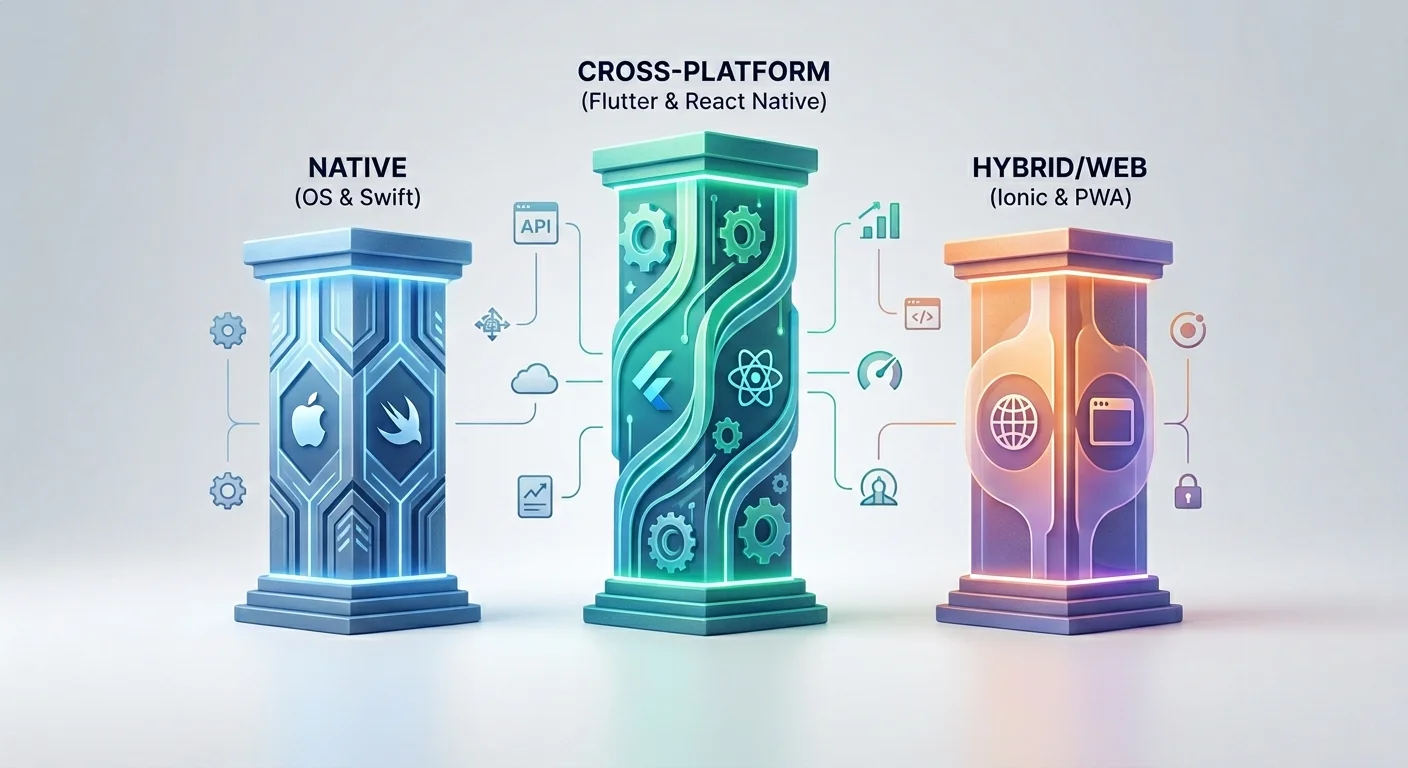
When clients ask for the top 10 programming frameworks for app development, they are usually looking for a leaderboard. In reality, the "best" framework depends entirely on the use case. However, we can categorize the leaders into strategic groups:
- Native Performance: Swift (iOS) and Kotlin (Android).
- Cross-Platform Efficiency: Flutter and React Native.
- Web-Hybrid: Ionic or Progressive Web App (PWA) technologies.
Decision-making factors should not be based on popularity contests. Instead, evaluate based on the availability of libraries for your specific industry (e.g., Bluetooth for healthcare, encryption for fintech) and the size of the talent pool available to maintain the code.
Framework Considerations for Healthcare App Development
In the healthcare sector, the framework choice is heavily influenced by compliance and data privacy. Healthcare app development requires strict adherence to regulations like HIPAA in the US and GDPR in Europe.
Native frameworks are often preferred for healthcare apps because they offer robust, built-in security modules that are harder to bypass. For example, using native APIs for secure storage (Keychain on iOS, Keystore on Android) ensures that patient data is encrypted at rest. Furthermore, healthcare app development often requires reliable offline functionality, a strength of native apps that manage local databases more efficiently than some web-based wrappers.
Framework Requirements for Fintech App Development
Similarly, fintech app development demands unshakeable security and low latency. When users are trading stocks or transferring funds, milliseconds matter. Native frameworks typically offer the deterministic performance required for high-frequency trading interfaces or real-time transaction processing.
Security is paramount. Fintech apps must be resistant to jailbreaking and rooting attempts. Native code provides better obfuscation tools, making it harder for attackers to reverse-engineer the application and exploit logic.
How App Development Companies Evaluate Frameworks
Experienced app development companies do not choose frameworks based on what is "trending." We evaluate based on project scope and long-term viability.
- Project Scope: A simple content delivery app may suit a cross-platform framework perfectly. A complex AR utility requires native power.
- Team Expertise: It is often more cost-effective to use a framework the team already knows rather than the "best" framework that requires a steep learning curve.
- Client Growth Roadmap: If the client plans to expand to wearables or TV, native integration stacks usually offer a smoother path.
When to Hire App Developers vs Partner with a Top-Rated Mobile App Development Company
Deciding between building an internal team and outsourcing is critical. When you hire app developers internally, you gain total control and cultural alignment. However, finding senior architects with niche experience in specific frameworks like Flutter or Kotlin is expensive and time-consuming.
Partnering with a top-rated mobile app development company provides immediate access to a multidisciplinary team. You gain not just developers, but QA engineers, UI/UX designers, and project managers who understand the nuances of the chosen framework.
Future-Proofing Your App Development Strategy in 2026
The code you write today must be ready for the infrastructure of tomorrow. Future-proofing involves adopting an API-first architecture. Whether you build in Swift or Flutter, your app should communicate with backend services through robust APIs. This allows you to swap out backend logic or scale independently of the mobile client.
Cloud-native integrations are also essential. Modern apps rely heavily on serverless functions and cloud databases (like Firebase or AWS). Your chosen framework must play nicely with these cloud ecosystems.
As we move further into 2026, the technology will continue to evolve, but the principles of solid engineering remain constant. Avoid trend-driven decisions. Align your framework choice with your business model.
If you are a startup validating a concept, cross-platform app development services likely offer the speed you need. If you are a bank or a hospital, native development likely offers the security and performance you require. At Boost Agency Ltd, we help you make that distinction clearly, so your foundation is built to last.