Meta Health and Wellness Ad Restrictions: What Supplement and Peptide Brands Can Still Do
Meta took away the purchase data health brands relied on. It didn't take away the channel. Here's what still works.
If you sell supplements, collagen or peptide skincare and your Facebook results fell off a cliff sometime in the last year, you're not imagining it. Meta's health and wellness ad restrictions changed how these accounts work. Plenty of brands found out the hard way: purchase data stopped flowing, campaigns lost their best signal, and cost per acquisition crept up week after week.
I've spent a lot of this year inside accounts like these, and the pattern rarely changes. The ads stayed the same. So did the product.
What changed is how much Meta lets the brand tell it about who bought.
Here's the good news. Supplement and wellness brands are still advertising profitably on Facebook and Instagram. They're just doing it differently. This guide covers what the rules actually say, how to tell if you've been flagged, and what you can still do about it, without shady workarounds that put your Business Manager at risk.
What Are Meta's Health and Wellness Ad Restrictions?
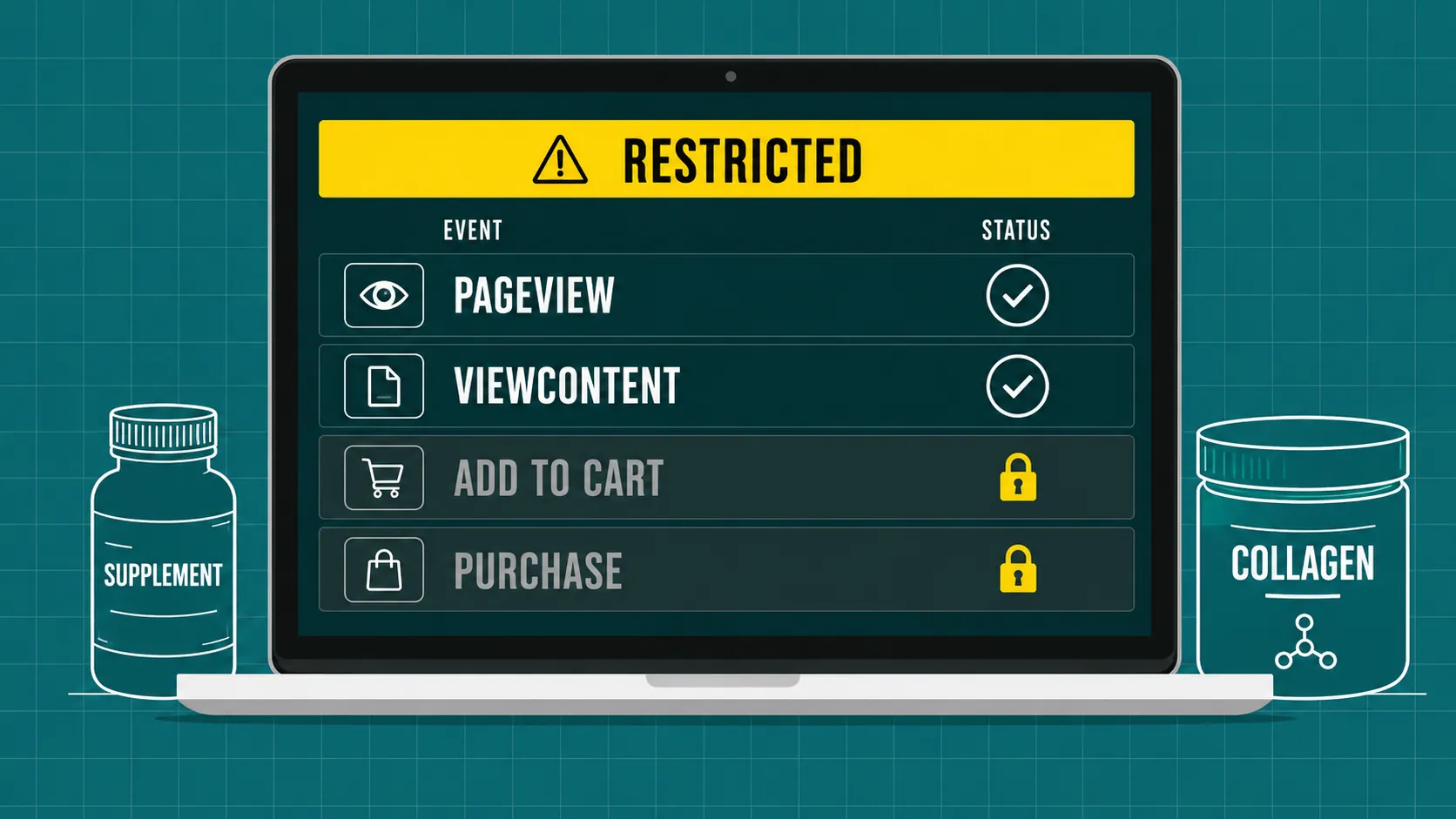
In January 2025, Meta started limiting the data that advertisers it classifies as health and wellness can share and use for optimization. The US went first. The headline change was simple and painful: flagged advertisers lost the ability to optimize campaigns for lower-funnel events like Purchase and Add to Cart.
Think about what that means in practice. A conversion campaign works because Meta sees who buys and goes looking for more people like them. Remove the purchase signal and the algorithm is flying with half its instruments switched off.
Meta frames this as protecting user privacy around sensitive health information. You can agree or disagree (I have opinions), but the policy isn't going anywhere. If anything, enforcement in 2026 has become stricter and more automated, with Meta's systems reviewing ad copy, images and landing pages together.
Two things get mixed up constantly, so it's worth separating them:
- Data restrictions limit what your pixel and Conversions API can send, and which events you can optimize for. This is the 2025 change.
- Ad content policies govern what your ads can say and show, like health claims, before and after photos, and references to a viewer's personal attributes. These have been around for years.
Most brands I speak with are fighting both at once. That's why the fixes further down cover both.
How Do You Know If Your Ad Account Has Been Flagged?
Meta doesn't send a dramatic email. The first sign usually shows up in your data:
- Events Manager warnings saying some of your events or parameters are restricted.
- Missing optimization options when you build a campaign, with Purchase and Add to Cart greyed out and Landing Page Views suggested instead.
- A gap between Ads Manager and your store. Reported purchases drop sharply while Shopify orders stay roughly flat.
- Shrinking custom audiences built from site visitors and past buyers.
Seeing two or more of these? Assume you've been classified and plan around it. You can request a review through Account Quality, but in my experience appeals rarely work for brands that genuinely sell health products. They're worth the effort when the flag is plainly wrong, like an office chair company being treated as a medical equipment seller.
Which Brands Get Caught by Meta's Health and Wellness Ad Restrictions?
More than most people expect. Supplements are the obvious category, but flags also land on collagen powders, sleep aids, protein brands, acne-adjacent skincare and fitness products. Meta classifies at the domain level by looking at your products and pages, so one cautious ad won't save you if the rest of the site reads like a pharmacy.
I'll be blunt here. Injectable peptides, research-use-only compounds and anything positioned as a drug alternative are effectively off-limits on Meta under its prescription drug and unsafe substances policies. No targeting trick or tracking setup changes that, and any agency promising otherwise is gambling with your accounts.
Peptides as an ingredient are a different conversation. Collagen peptide supplements and cosmetic peptide serums can run on Meta, as long as the claims stay inside the rules. Those are the peptide brands this guide is written for.
What Supplement and Peptide Brands Can Still Do on Meta
Now the useful part: working with Meta's health and wellness ad restrictions instead of against them. No single fix brings back 2024 performance. Stacked together, though, these are the changes we make on every health and wellness account we take on.
If Purchase is off the table, Meta will usually let you optimize for Landing Page Views or View Content. Do it, but stop judging those campaigns by the ROAS Ads Manager reports. That number will look awful because Meta can't see most of your sales anymore.
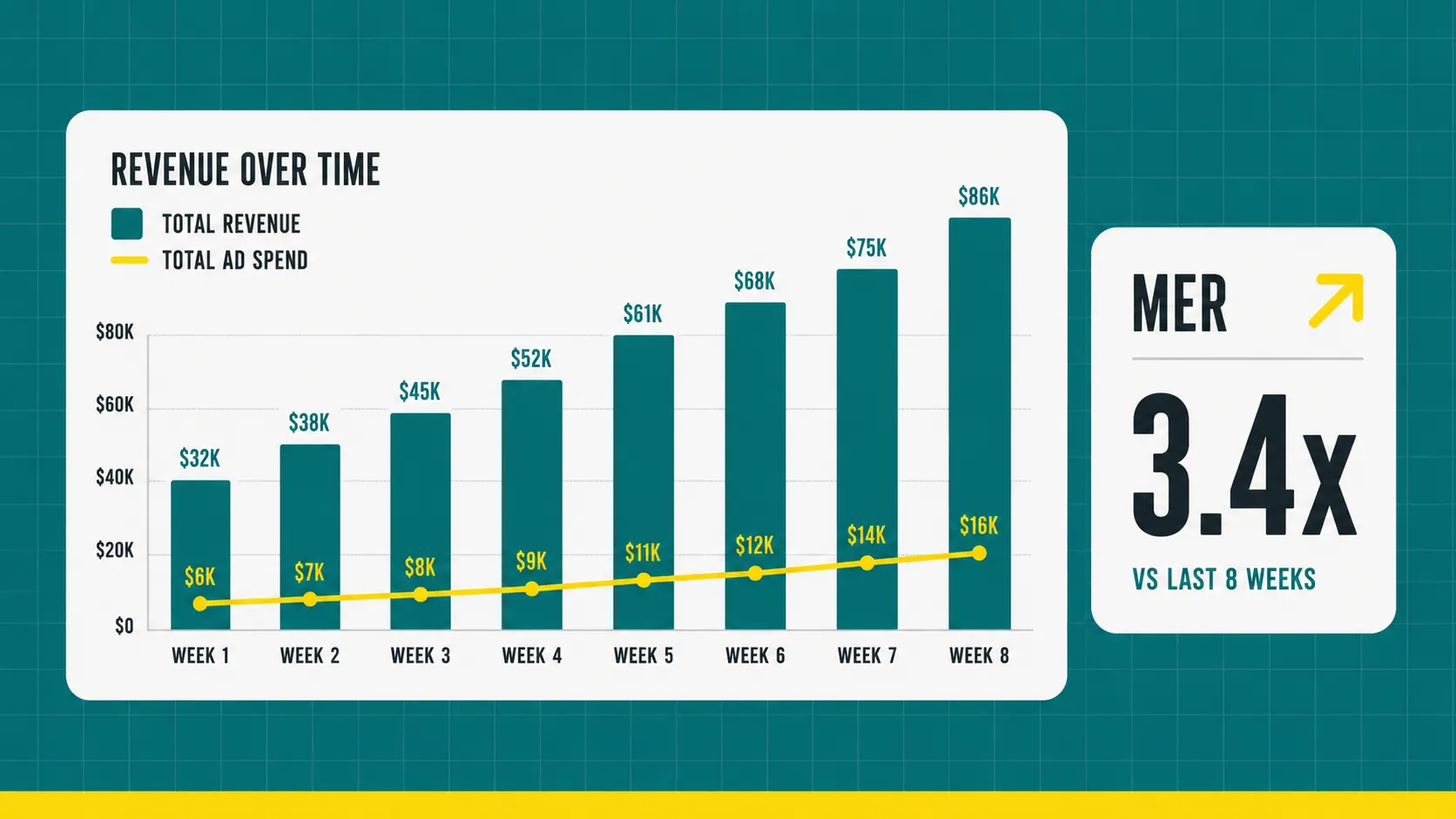
Judge them on blended numbers instead. Take total store revenue, divide it by total ad spend (your MER), and check it weekly against Shopify. Say you were spending £300 a day and store revenue held steady after the switch. The campaign is still doing its job, whatever Ads Manager claims.
One honest caveat: upper-funnel optimization brings in more browsers and fewer ready buyers. Your creative and landing page have to carry more of the selling now.
A lot of brands make their situation worse by sending sensitive information to Meta without realizing it. Product names like "Joint Pain Relief Complex," URLs with condition words in them, and custom parameters describing health goals all count.
Set up the Conversions API properly through your store's native integration or a server-side setup, and keep health-related details out of your event parameters. Meta's own business terms already say not to send this kind of data. You're not hiding what you sell. You're just not handing over information you were never supposed to share, which is often what triggers the tightest restrictions in the first place.
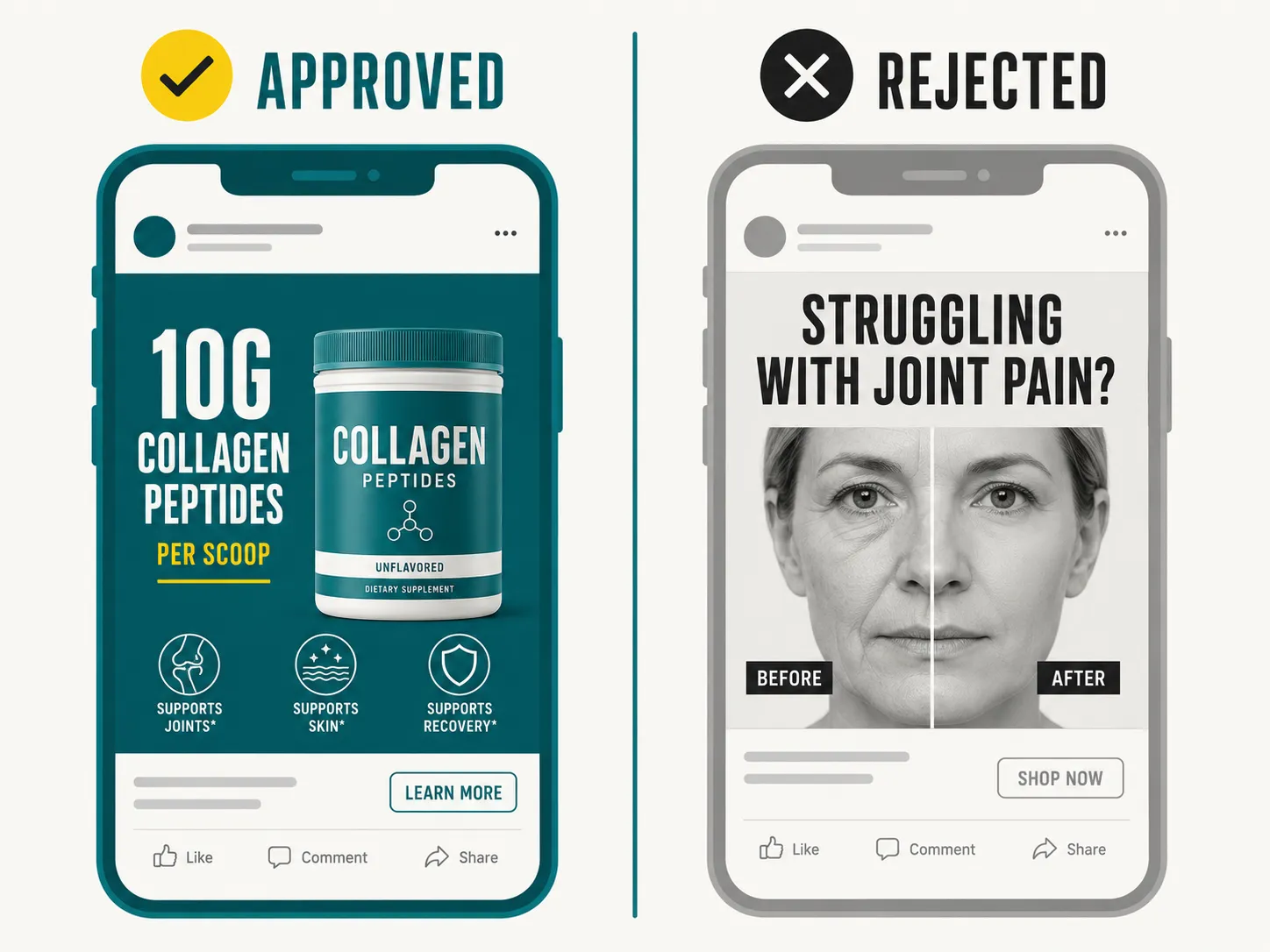
Meta's personal attributes policy causes more rejections than anything else in this niche. "Struggling with joint pain?" implies the viewer has a condition, so it's out. "Our collagen blend has 10g of hydrolyzed peptides per scoop" is fine.
- Lead with ingredients, sourcing, taste, routine and price.
- Drop before and after photos completely.
- Avoid cure, treat and prevent language, along with any guaranteed result.
- Show real people using the product in everyday settings instead of "problem" shots.
UGC-style videos do particularly well here. They feel like a friend's recommendation rather than a medical claim, and Meta's reviewers seem to treat them that way too.
Meta reviews where the click goes, too. A squeaky-clean ad pointing at a page that promises to "reverse ageing" will still get you in trouble. In the UK and EU, supplement health claims also have to come from the authorised health claims register, so check every product page against it before scaling spend.
Our funnel marketing team spends about as much time on landing pages for health brands as on the ads themselves. Honestly, that's where most of the fixable problems live.
Meta removed detailed targeting options tied to health conditions back in 2022, so "target people interested in arthritis" has been dead for years. Broad targeting plus a steady flow of new creative is what works now. Aim for three to five fresh concepts a month, each with its own angle: an ingredient story, the founder, a customer's morning routine, a cost-per-serving comparison.
Every email and SMS subscriber you collect is a customer you can reach again without asking Meta's permission. Run offers built to capture contacts, like a product quiz or a starter-pack discount, then work hard on retention. When acquisition costs rise, repeat purchases are where the margin comes back.
Spreading budget helps as well. Google Ads has its own healthcare rules, but search intent means you're reaching people already looking for what you sell.
Mistakes That Make the Restrictions Worse
Some of the "fixes" floating around online will cost you far more than the restrictions ever did.
- Opening new ad accounts or Business Managers to escape the flag. Meta links them, and it can escalate into a full ban.
- Cloaking landing pages so reviewers see one page and customers see another. This is the fastest way to lose an account permanently.
- Renaming events to something generic and assuming the problem is solved. Meta reads the whole event, not just its label.
- Killing campaigns too early because reported ROAS dropped. Check real revenue before you pull the plug.
- Rewriting ads for the fifth time while ignoring the landing page that's actually causing rejections.
We've written more about running profitable ads in restricted niches if you want to see how the same thinking applies to crypto and CBD.
Is Meta Still Worth It for Health and Wellness Brands?
For most supplement and cosmetic peptide brands, yes, even with Meta's health and wellness ad restrictions in place. Facebook and Instagram are still where a big share of buying decisions happen for these products, and no other platform offers that reach at a similar price.
What's changed is the maths. Expect a higher cost per purchase than you saw in 2024. Expect Ads Manager to undercount sales. Build budgets around margin and customer lifetime value rather than first-order ROAS.
Brands that accept the new reality and adjust usually keep growing. The ones waiting for Meta to reverse course are, for the most part, still waiting.
Meta's health and wellness ad restrictions took away the easy version of Facebook advertising for supplement and peptide brands. They didn't take away the channel.
Optimize for the signals you still have, judge results on real revenue, keep sensitive data out of your tracking, and write ads about your product rather than your customer's problems. Pair that with honest landing pages and an audience you own, and Meta can still pay its way.
The brands that struggle are usually the ones hunting for a loophole. The ones that do well put that same energy into better creative.
Purchase Data Gone Quiet on Meta?
If your events are restricted or your supplement ads keep getting rejected, our Facebook ads team can review your account, tracking and landing pages and show you what's still possible for your brand.
Talk to Our Meta Ads Team